

Let’s Help Prepare you for YOUR Retirement:
No two retirements look the same - yours won't either. Below, you'll find a selection of articles written to help you put words to something you might not have realised needed articulating. Sometimes the hardest part isn't finding the answer; it's not knowing there was a question worth asking in the first place.
If you'd like a feel for how I think about retirement - or a sense of what working together might actually be like before you commit to a call - start with the blog. It's the closest thing to sitting in on a conversation with me.
Why some retirement problems are difficult to solve alone
The emotional transition into retirement can be far more complex than many people expect.
Questions can quietly emerge such as:
Who am I, now that I no longer work?
Where will my social connections come from?
What gives my life structure and purpose now?
These are not small questions.
Many people try to solve these uncertainties through private reflection. There is nothing wrong with that. But you can think long and hard about why you feel unsettled, and still remain stuck.
Sometimes the missing ingredient is not more thinking, but conversation.
What do I mean by that?
Other people often help to normalise experience. It can be surprisingly reassuring to observe how others navigate retirement, both successfully and unsuccessfully. Their experiences may help you recognise aspects of your own situation more clearly.
Conversation can also create clarity. Speaking honestly with trusted friends or family members may help you understand what is really troubling you beneath the surface.
Many people hesitate to seek help because they believe struggling emotionally in retirement means they have somehow failed. But uncertainty, loneliness, loss of identity and lack of purpose are far more common than most people realise.
You do not need to work through all of this alone.
The early years of retirement are precious. They are often the years in which you still have the greatest freedom, energy and health. For that reason alone, it may be worth thinking carefully about how you want to live them.
If you would find it useful to have a brief, obligation-free conversation about your own situation, you are very welcome to text me on:
0409 116 766
Dr Jon Glass
Retirement Specialist and Coach
Friendship and retirement
Introduction
Friendship is a surprisingly difficult word to define.
People often speak about three broad categories:
Close friends – which may relate to high frequency of contact and disclosure of personal information
Friends – which may simply mean less frequency of contact
Acquaintances – might be people you catch up with occasionally
Most of us understand these distinctions intuitively, even if we struggle to define them clearly.
But what more can we say?
Some uncomfortable facts about friendship in retired life
Research suggests that:
Women are more likely than men to have close friendships
A significant number of people report having few or no close friends
That is worth pausing over.
Friendship is not simply a pleasant extra in life. Strong social connection is closely tied to emotional wellbeing and mental health.
In retirement, this can become particularly important because many of the social structures built into working life suddenly disappear.
If this topic feels relevant to you, you can download my free retirement checklist here:
https://www.64plus.com.au/free-resources
The challenge of making friends in retirement
One of the unexpected challenges of retirement is that making new friends can become harder.
At work, connection often happens naturally through:
shared routines
shared frustrations
regular contact
banter
In retirement, social connection usually requires more deliberate effort.
One of the best ways to rebuild connection is through a shared pursuit. Volunteer work, community involvement, and learning environments such as courses or group activities can all create opportunities for genuine friendship to develop over time.
Friendship is a very broad topic so you may enjoy hearing some other perspectives.
Podcast
My podcast Talk About Friends explores many different perspectives on friendship and social connection.
You can listen here:
https://open.spotify.com/show/5aahOAoqNOcfLn2WhWtdXy
Conclusion
Friendship may be difficult to define, but most people recognise its absence immediately.
Retirement can quietly expose gaps in social connection that working life once concealed. Recognising that reality is not a failure. It is simply a reason to think more carefully about how you want to build connection in this next stage of life.
Me presenting to over 200 people at an AMP retirement seminar.
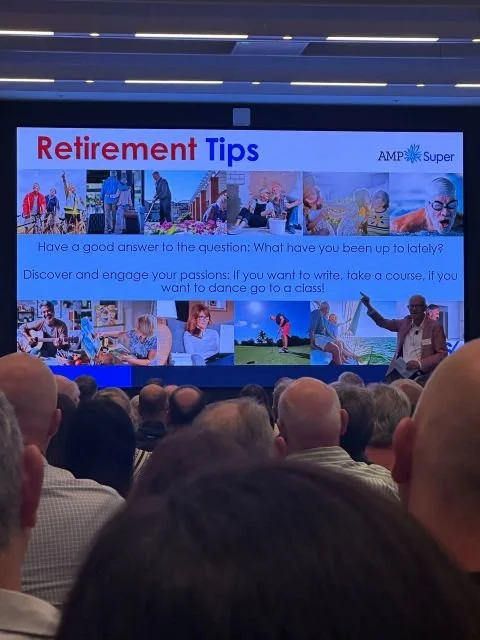
Note my signature pink jacket. The energy in the room was high!
Why is it that some people feel invisible in retirement? And worse still, do they feel unheard?
When I was growing up, our family had a dog. One day, after doing something it shouldn’t have done (I can’t remember its indiscretion), the dog tried to hide from us by putting its head under a table. The rest of its body was completely visible.
We could see it clearly. The dog, however, seemed to believe it had disappeared. We had a quiet chuckle.
That image has stayed with me because it says something about a concern many people have as they get older, and particularly in retirement. The fear of becoming invisible, so you are:
-seen less
-not noticed in the same way any more
-no longer in the centre
There might be truth to that. I've heard it said that it's a fear that afflicts women more than men. That may be true, but I don't have a theory about that.
But sometimes people forget that there's a second condition: you become unlistened to, not just unseen, but unheard. It may manifest as:
-people no longer seek your opinion
-your voice carries less weight in everyday conversations
-decisions are made without you
That can be confronting. So what can you do?
The instinct, like our dog, may be to withdraw slightly. But that rarely helps. It’s better to acknowledge what is happening and think carefully about how you want to respond to it.
There are ways to rebuild connection and influence in the retired phase of life.
If this feels like you, it may be worth thinking it through with someone.
You are welcome to start an obligation-free conversation here:
https://www.64plus.com.au/contact
Or, if you would prefer a quieter starting point, you can download 64PLUS’ free retirement checklist here:
https://www.64plus.com.au/free-resources
Dr Jon Glass Retirement Specialist and Coach
Why retirement can feel meaningless, after success at work.
In your work life you may have reached the summit of success, only to discover that in retirement your life feels off kilter. What might that look like? You could feel any or all of:
· Directionless
· Unmotivated
· No longer valued
· Invisible
· Socially isolated
What is going on here?
We’re not talking about money, that part of your life may be just fine. Also your physical health could be great for your age.
And still something is gnawing away.
If this topic feels relevant to you, you can download my free retirement checklist here.
https://www.64plus.com.au/free-resources
You do not need your family to tell you all this. You can see it in their eyes. For many people in retirement this is unexpected.
The reason for these feelings is:
You have not yet worked through your sense of meaning and purpose in retirement; something that was built into your working life.
If this feels difficult to work out on your own, this is exactly the kind of transition a retirement coach can help you think through.
For an obligation-free chat about your circumstances, you are welcome to reach out at
https://www.64plus.com.au/contact
Retirement is often described as freedom, but for many people it can feel more like a loss of direction.
If some part of this article resonates with you, pause to consider what is missing, rather than simply trying to stay busy.
You don’t have to resolve it all at once. If you’d like a place to start, you can download the free retirement checklist here.
https://www.64plus.com.au/free-resources
Dr Jon Glass Retirement Specialist and Coach
How to build social connections in retirement
You can leave work, but it can be hard to leave behind the network of social connections that work provided.
In a recent article we explored why this happens:
https://www.64plus.com.au/blog/2026/3/30/why-friendship-at-work-is-hard-to-replace-in-retirement
It leaves an important question to answer. In retirement where will your regular, natural social connection come from?
If this topic feels relevant to you, you can download my free retirement checklist here.
https://www.64plus.com.au/free-resources
There is no single answer, but here are two reliable ways to begin rebuilding connection. I know this because I’ve tried both of them, with success.
1. Volunteer for a shared cause
Volunteering creates connection because it brings people together around something that matters to them.
-You are not just passing time.
-You are contributing alongside others who have chosen to be there.
That shared purpose makes conversation easier and more natural.
2. Learn something new with other people
Learning a new skill places you in a group that shares a common challenge.
-There is uncertainty, progress, and small wins along the way.
-These shared experiences create natural opportunities for connection.
Over time, familiarity can turn into something more meaningful.
What this really means
Social connection in retirement rarely happens by accident.
At work, it was built into your day. Now, it has to be created more deliberately.
If you are finding this difficult, working with a Retirement Coach can help you think through where meaningful connection is most likely to emerge for you.
Next steps
Retirement is harder than most people expect, emotionally not just financially. If you are experiencing that difficulty then let’s talk. A free 15 minute call costs you nothing, but may change everything. Contact Jon at 0409 116 766 or jon@64plus.com.au
Conclusion
Social connection in retirement is a crucial component of flourishing. However, it typically doesn’t happen by itself, it needs work. Don’t be put off, there are ways to make it happen.
You may also find this article helpful:
This is the third of three articles.
Dr Jon Glass Retirement Specialist and Retirement Coach
Why friendship at work is hard to replace in Retirement
You can leave work, but it can be hard to leave behind the network of social connections that work provided.
Many people cross the bridge into retirement with a vague sense that something is missing. Not dramatic. Not urgent. Just… an itch they can’t quite locate.
Then it becomes clear: Work gave social connection, without you having to think about it.
The hidden value of work: everyday connection
This may not have been your exact experience, but for many people, work provided a steady stream of human interaction.
Conversation. Shared purpose. Recognition. And for some the simple pleasure of banter.
That banter matters more than it seems. It’s not just light conversation. It’s a signal:
· that you belong
· that you are seen
· that you matter
Most of us need this. (Lighthouse keepers may be the exception.)
One of the surprises in my own semi-retired life has been that banter doesn’t easily transfer into retirement.
Why Retirement feels socially different from work
When you retire some structure disappears.
-No automatic interactions.
-No shared context.
-No daily rhythm of people around you.
What’s missing is social connection,which raises an important question:
What all this means for your Retirement
If social connection mattered in your working life, it will matter just as much, if not more, in retirement.
But now, it is no longer built in, it has to be designed.
If you’re finding it difficult to rebuild that sense of connection, working with a retirement coach can help you manage this.
Answering the question: Where will my regular, natural social connection come from? can reshape how you approach retirement.
Conclusion
Retirement is a time to rethink social connections, where they come from, and how to maintain them.
You’re welcome to start a conversation about this topic here:
https://www.64plus.com.au/contact
You may also find this related article helpful:
https://www.64plus.com.au/blog/2026/3/28/why-you-can-feel-lonely-after-retirement-even-when-youre-busy
This is the second of three articles.
Dr Jon Glass
Retirement Specialist and Retirement Coach
Why You Can Feel Lonely After Retirement — Even When You’re Busy. Why staying busy doesn’t always create connection.
You can have a full calendar in retirement, and still feel unexpectedly lonely.
If that’s happening to you, you’re not alone, and there’s a reason for it.
At first, that may sound strange — even a paradox.
Why being busy doesn’t solve loneliness
But it becomes easier to understand this paradox if you consider a simple idea I often use:
BINAM — Busy Is Not Always Meaningful.
Many people assume that a full calendar will naturally lead to a fulfilling and connected retirement. In practice, this is often not the case. Meaning is not created by activity alone; meaning has to be discovered and nurtured.
Consider a simple example in retirement. You take up a sport: pickleball for instance. It keeps you active and gives your week a sense of shape. But more importantly you are also hoping it will provide connection, a chance to spend time with people whose company you genuinely enjoy.
Suppose you realise something unexpected: they are not quite “your people”. Now you feel the cold hand of loneliness on your shoulder.
What is the answer?
Is the answer: find different people, or rethink your approach entirely?
This is one of the most common issues people bring to a retirement coach; not a lack of activity, but a lack of meaningful connection.
If this feels familiar, you can download my free retirement checklist here.
https://www.64plus.com.au/free-resources
What loneliness in retirement is really telling you
Loneliness in retirement is often a signal, a quiet indication that something meaningful is missing. It invites reflection: not just on how you spend your time, but on who you spend it with, and why.
If you’re finding it difficult to rebuild a sense of purpose or connection, working with a retirement coach can help you make sense of this transition and design a more meaningful structure for your time. Follow the link:
Conclusion
A fulfilling retirement is not built simply by filling up a calendar, but by shaping it around what truly matters. Social connection is one such thing.
You may also find this companion article helpful:
https://www.64plus.com.au/blog/2026/3/4/making-decisions-about-your-retirement
This is the first of three articles.
Dr Jon Glass Retirement Specialist and Retirement Coach
How to Create Structure in Retirement (And Find Meaning Again). One of the biggest challenges in retired life is creating structure now that the framework of a worklife has gone.

One of the hidden challenges of retirement is not lack of time but how to shape that time and how to use it.
In two previous blogs we discussed decision making in retirement:
https://www.64plus.com.au/blog/2026/3/4/making-decisions-about-your-retirement
Then we added a second set of reflections on the topic in:
In the second article we discussed:
· Structure
· Deadlines
· Choice
Now let’s go further. Retirement offers a wonderful gift: the gift of time, perhaps 10,000 days! Let’s unpack the trio above, in the context of time:
· Structure carries with it a lovely idea called “pace”. In retirement you set the pace. How busy do you want to be? I coined the acronym BINAM = Busy Is Not Always Meaningful, which will guide you to meaningful activities that generate the pace you desire.
· Deadlines are good in retirement (not too many) as they can set a mini-framework for a day or a week and allow you the pleasure of achieving desirable output (maybe learning a new tune on your ukelele)
· You feel like you are the master of your choices. Isn’t that great?
As I said in the previous article, finding your meaning and purpose is not simple, but there is help.
If these ideas resonate you may want to explore them in a conversation:
https://www.64plus.com.au/contact
Finally, you may find this older blog on motivation useful:
https://www.64plus.com.au/blog/2024/12/20/hki6r0l3h1xqlufzba9dqjs4ihfxwu
This blog is part of a series on decision making in retirement.
Dr Jon Glass Retirement Specialist and Coach.
Why Retirement Feels Harder Than Expected: The Problem with Too Much Freedom

Many people believe that retirement gives freedom and that freedom will make life easy. But it’s not that simple. So why is it that too much freedom can make retirement harder than expected?
This may sound surprising, but it’s a very common experience, especially after the honeymoon period is over. How can that be? Well in retirement, as in life generally, decisions need to be made. But now it feels different.
In a previous blog we discussed the strangeness of decision making in retirement:
https://www.64plus.com.au/blog/2026/3/4/making-decisions-about-your-retirement
Let’s return to the issue of freedom in retirement. After you leave your work life three realisations come to you:
· You have lost a structure which for most people was Monday to Friday 9 to 5.
· There are no external deadlines any more
· Choice offers a bizarre paradox: too much choice can lead to decision paralysis (think of the selection of jams and chocolates at the supermarket)
What is to be done? Simple: find your meaning and purpose in retirement and you will quickly find a suite of activities that:
· Gives a structure and routine that pleases you
· Shows the usefulness of deadlines in retired life (but not too many)
· Choices gets limited
Now the path to finding your meaning and purpose is not simple to find, but there is help.
If these ideas resonate you may want to explore them in a conversation:
https://www.64plus.com.au/contact
This blog is part of a series on decision making in retirement. The next instalment is at:
Dr Jon Glass Retirement Specialist and Coach.