

Let’s Help Prepare you for YOUR Retirement:
No two retirements look the same - yours won't either. Below, you'll find a selection of articles written to help you put words to something you might not have realised needed articulating. Sometimes the hardest part isn't finding the answer; it's not knowing there was a question worth asking in the first place.
If you'd like a feel for how I think about retirement - or a sense of what working together might actually be like before you commit to a call - start with the blog. It's the closest thing to sitting in on a conversation with me.
Seven things that surprised me when I retired
The following words ring true for me.
Retirement: You won’t know what it is like until you get there.
Our society loads lots onto the word “retirement”. As I discovered, retirement’s not as simple as downing tools and relaxing. Then what are some of the surprises that I discovered?
1. Retirement can last a long time
Perhaps 10,000 days, which is a lot of time to fill with meaning and purpose and intention.
2. Your health
Work no longer offers an excuse to ignore your health, as you now have the time to focus on wellbeing. Engage in regular exercise and maintain your doctors’ appointments.
3. The gift of time
Your time in retirement is a gift to you. Make good use of that gift to do whatever gives you meaning.
4. Domestic life
Where you live, apartment or house, in the case that you live with a partner, becomes joint space seven days a week. Share it wisely and well and, most of all, discuss and negotiate the space.
5. The power of self-reflection
You have the chance to think deeply about yourself, and your relationships with family and friends. Do it! Good emotional hygiene delivers great benefits.
6. New experiences
Don’t hesitate to try a new hobby, or take a course. So what if you fail. You don’t have a boss who’ll get angry with you.
7. Kindness
Most of all, be kind to yourself. Self-compassion delivers emotional benefits.
There are many more surprises. A retirement coach can help, not only to uncover them, but then assist you to make the most of them.
Re-imagine your retirement with 64PLUS, visit www.64plus.com.au to find out more.
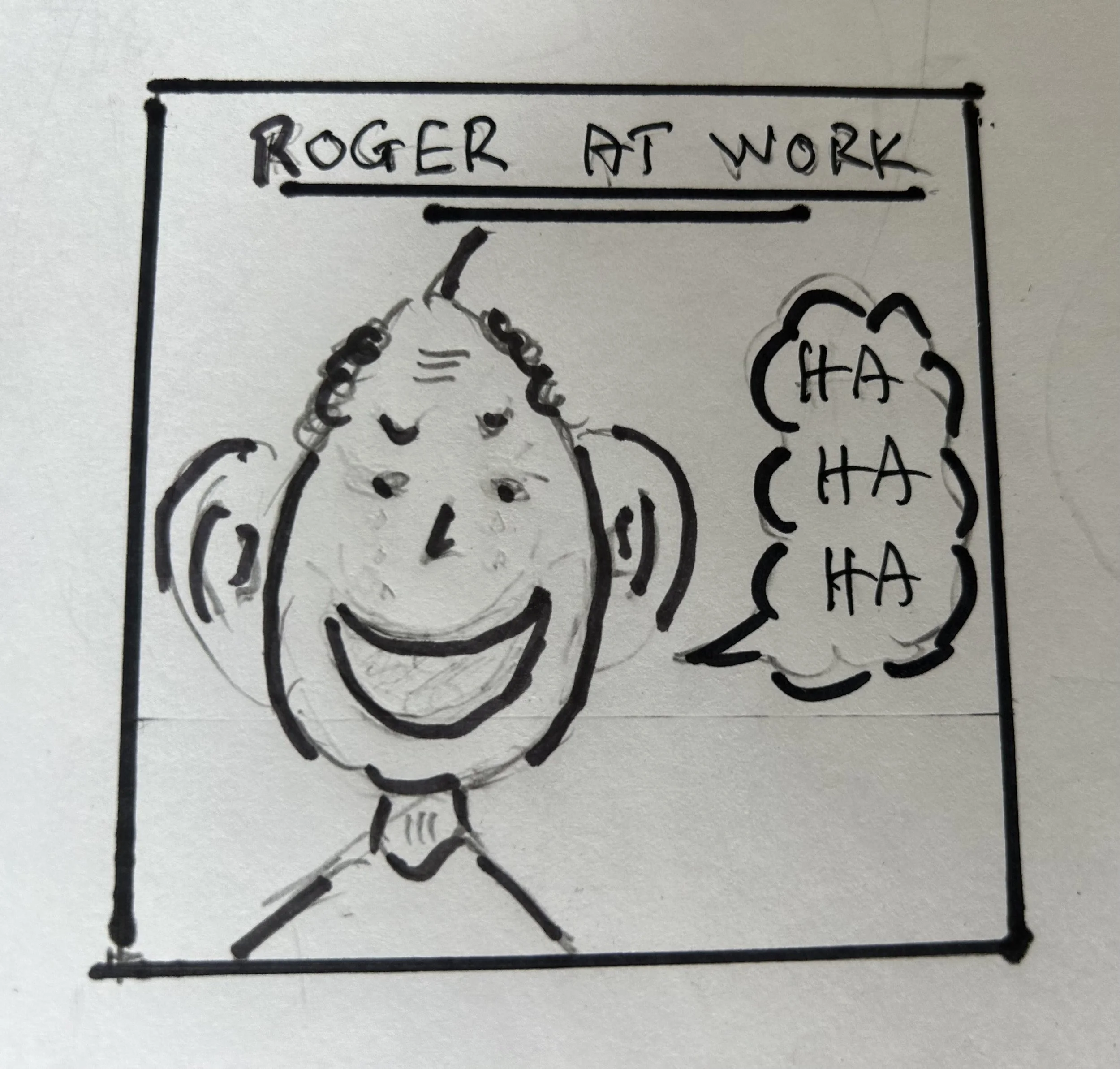
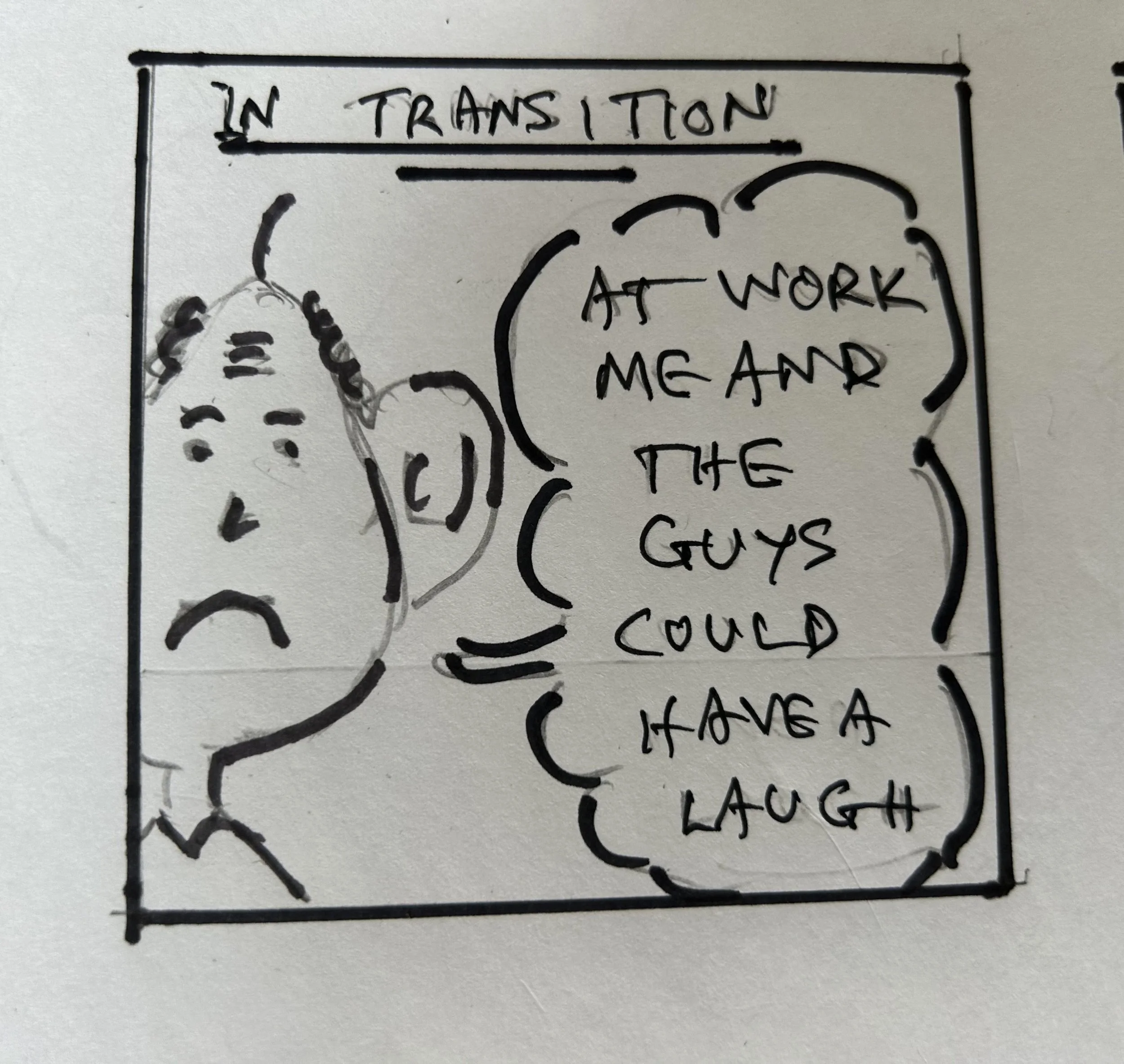
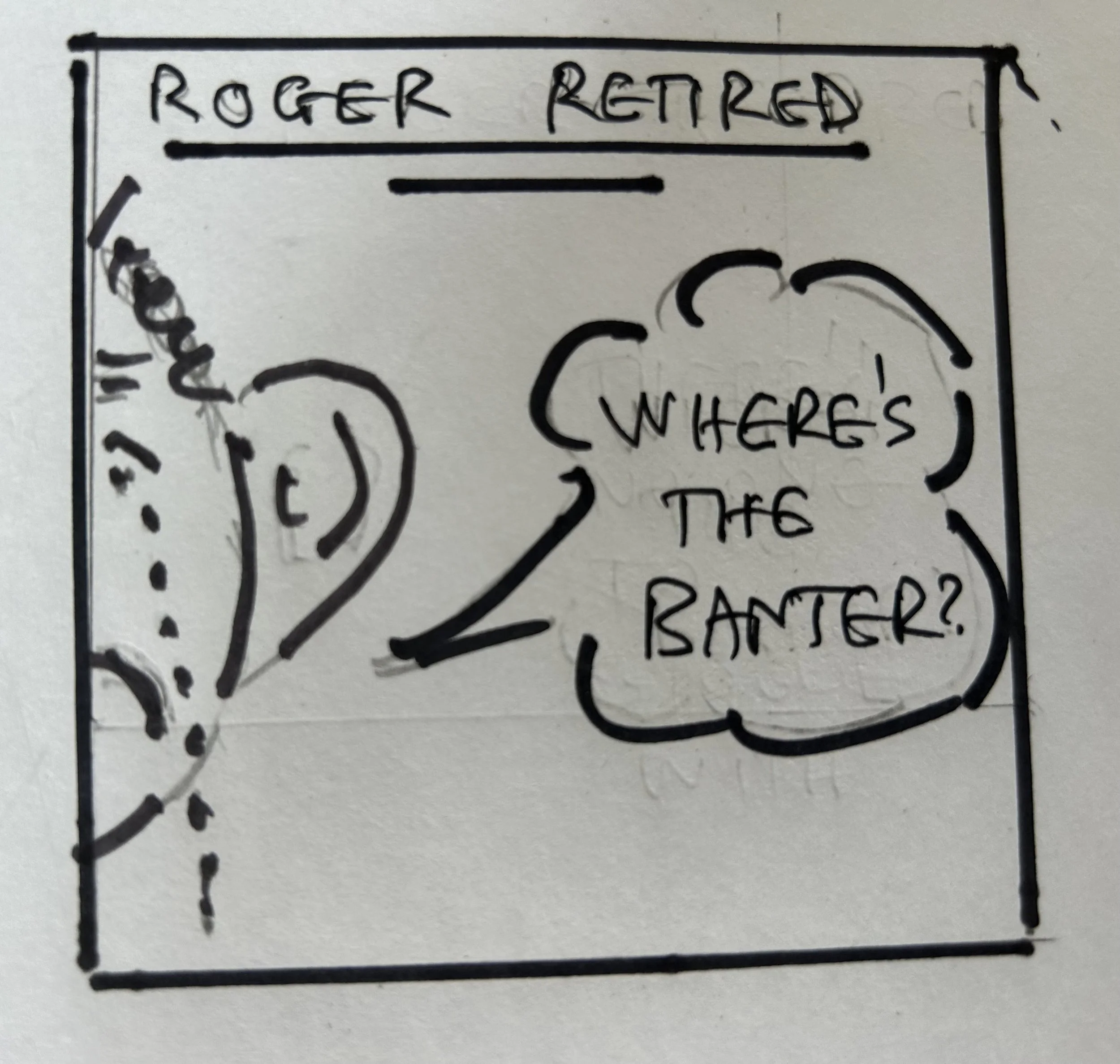
At work you can have a laugh with colleagues, but when you’ve retired….?????
Meet Roger the Retiree, please read the 3 frame cartoon by scrolling down. Roger has a realisation about his retired life that strikes him like a bolt of thunder and a flash of lighting. I think this is a phenomenon for all retired people, but it’s the retirement coach who can help you to come up with YOUR response to this dilemma. And there will he one! I can help. Reach me via this website.

A long-form interview with me
This interview gives an in-depth introduction to the 64PLUS approach to retirement coaching. I hope you enjoy it.
Click the link below.
Words Matter

WORDS MATTER
We all know the choice of a word can matter. But that’s very general, what more can be said? A word may be precise in its meaning but lack an emotional appeal, while a word that appeals emotionally may lack precision. Here is a simple example. The word “tractor” has a precise meaning but little appeal (to my ears), however “fair” has a strong fragrance yet is imprecise as it can mean many things.
The balancing act between precision and appeal is not simple to accomplish. But as you will see very soon it is an important balance to strike.
I recently had the chance to conduct a poll in which I asked people to vote on a potential term to replace the word Retirement. I'll come back to why a replacement for the word Retirement is a good idea. But first the four replacement terms chosen were:
· Adventure
· Work detox
· Post work
· Renaissance
Why does the word “Retirement” need to be retired? Apparently the term Retirement is a mediaeval French word to describe how a person - after a life of work – might withdraw to a monastery to contemplate life.
And although many might not be aware of this etymology, I know from years of experience as a Retirement Coach, that the word Retirement is freighted with enough negativity to be off putting. That association may even make people reluctant to engage fully with life in Retirement.
Back to the poll. Adventure and Work detox came a distant last, while Post work came a close second to Renaissance, which was the winner.
So what's wrong with Adventure and Work detox? To analyse this I want to return to our discussion of precision vs appeal in a word. I suspect Adventure sounds temporary in duration and in fact reminds me of what I talk about often, which is the honeymoon period of retirement. The honeymoon period tends to last a few months and then poses the question “What next”. On the other hand, Work detox is such a negative expression. I wonder was anyone's job all that bad?
Let's move to the winner’s circle. Post work is a very precise term that probably suffers from its precision. It says almost nothing in terms of what can come after a working life and the potential for good things to emerge.
However, Renaissance has an exciting and pertinent feel to it. I think also, being associated with a glorious and critical phase of history, it shines brightly in peoples’ minds. Although historians sometimes argue that the Renaissance wasn't everything it was cracked up to be and, in particular, the Dark Ages had a bit of light about them.
In summary, words matter. That polarity of precision and appeal is a good one to investigate. As the poll results suggest the word Renaissance is probably more effective than Retirement. Which makes me think I could rename my on-line self-study course.
Finding Joy in Your Renaissance. Hmmm. Perhaps.
What do you think? Do you have another word to replace Retirement? Let me know: jon@64plus.com.au
Identity in retirement: roles and narratives
When you worked you had a certain identity. Retirement is the point where you can springboard to a new identity. Of course when I say identity I’m not thinking plastic surgery with a new surname.
I have in mind two aspects of your life: Roles and Narrative. What are they?
· Roles are defined by job functions, activities and your position in your family and community.
· Narrative consists of the stories you tell about your life and how you want it to unfold in the future.
I’m sure you were/are very clear on your Roles and Narrative in your worklife.
In order to draw a bead on both of them in your retired life, here is a short questionnaire to fill out.
1. Roles
When you worked were you a problem-solver, good with clients, excellent at office politics, good at nurturing others? These are examples, you will have your own answers.
In retirement what do you want to be: a friend, a grandparent, a learner, a helper? Again you will have your answers.
I emphasise the plural “answers” because you will be defined by many roles in retirement.
2. Narrative
This is the part I find most interesting.
What stories do you/did you tell about your working life?
Now for your retired life. What stories would you like to tell about yourself? As a concluding exercise try to sketch out how the transitions of roles and narratives may play out. For example:
· I mentored staff at work, and I want to continue with that in retired life.
· In the last few years of work I was bored and unmotivated, but in retirement I want to re-invent myself and please my family.
Volunteering: applying skills from your work life.
It is extremely common for retired people to wish to “give back to society” via volunteering.
What skills from your work life might you apply to voluntary work in YOUR retirement?
The Michelangelo Effect
Years ago, a friend of mine quietly told her partner she wanted to write a novel.
He didn’t laugh. He didn’t brush her off or say “that’s nice, honey.”
Instead, he rearranged their weekends so she’d have time to write. That simple gesture didn’t just help her finish the book.
It made her feel seen. It made her feel loved. Psychologists have a beautiful name for this kind of support: The Michelangelo Effect.
What is the Michelangelo Effect?
Just as Michelangelo believed an angel was hidden within a piece of marble, waiting to be freed by his chisel, we too can help reveal the best in those we care about, “sculpting” their potential.
When we believe in our friend’s or partner’s dreams—and act on that belief—it helps them become more of who they’re meant to be. And surprisingly, it also brings us closer together.
Psychologist Caryl Rusbult and her colleagues found that people who felt supported by their partners made real progress toward their ideal selves in just four months. [1]
Even better? That kind of support is often returned. The more you believe in someone, the more they believe in you. And, over time, this creates an enduring connection between you and the people who need you the most (and vice versa).
Why It Matters for Your Relationship
Supporting someone’s growth isn’t just good for them, it’s good for you, too. Married researchers Art and Elaine Aron found that one of the main reasons we form close relationships is to grow. We want to expand our sense of who we are through shared experiences, emotional support, and common goals. [2]
The strongest relationships, they suggest, aren’t just about loving who someone is today—they’re about believing in who they could become tomorrow.
It’s not just saying: “I love you as you are.” It’s also saying: “I see who you’re becoming, and I want to grow with you.”
The Michelangelo Effect Works Best When It’s Mutual
This dynamic doesn’t need to be perfectly balanced. But it works best when both people are showing up.
If you’re always the one giving support—and your partner isn’t engaged in their own growth—it can start to feel lonely.
This isn’t a reason to give less. But it is a reason to give intentionally to someone who’s also choosing to grow.
How to Put the Michelangelo Effect to Work Today
You don’t need a grand gesture. Just a small act of belief.
Here are five ways to start:
· Protect time for their goals → Rearrange your schedule or run an errand so they have 90 distraction-free minutes to write, apply, or practice.
· Encouragement through doubt → When I experienced imposter syndrome during my first year as a professor, a colleague said, “Your students see you as a professor. You just have to believe it too.” That one sentence totally helped boost my confidence.
· Name their strengths out loud → Especially when they’ve forgotten them.
· Help them stay focused → Gently steer them away from distractions (like scrolling) when you know they’re trying to achieve a big goal.
· Let them know their dream matters to you → A friend almost didn’t apply to grad school because it felt like a long shot. I told her, “I don’t care if it’s unlikely. I just want you to try.” She did. She got in.
These little moments compound, and they don’t just help someone grow… they help you deepen your relationship too.
One Last Thought
Has someone ever believed in you—quietly, consistently—when you needed it most? Send them a quick thank-you today. A few words from you might mean the world to them.
by Sonja Lyubomirsky
References:
[1] Rusbult, C. E., Finkel, E. J., & Kumashiro, M. (2009). The Michelangelo phenomenon. Current Directions in Psychological Science, 18(5), 305–309.
[2] Aron, A., & Aron, E. N. (1996). Self and self-expansion in relationships. In G. J. O. Fletcher & J. Fitness (Eds.), Knowledge structures in close relationships: A social psychological approach (pp. 325–344). Mahwah, NJ: Erlbaum.
A client’s view of retirement coaching
My retirement planning has focused almost exclusively on finances. Will I have enough super and how much is enough? I now realise I haven’t given nearly enough thought to how I want to live in retirement.
Sure, I had a vague bucket list. Freedom to do what I like, when I like. Learning to play the piano, improving my French, local and overseas travel, and writing for pleasure. And did I mention freedom!
What I didn’t have was a plan. After being in the workforce for more than 40 years, retirement is like a foreign country – a mirage shimmering on the horizon but always out of reach. Only now it’s within reach and part of me wonders if money was the only thing holding me back.
Could it be that work is a comfort zone I’m reluctant to leave? I enjoy my work, the sense of identity it gives and the satisfaction of being ‘in the loop’.
To help answer these questions, I enlisted the help of retirement coach Jon Glass, founder of 64 PLUS, who focuses on the non-financial aspects of retirement. We explored my attitudes to work and retirement, my values, goals and priorities. And crucially, what activities would not only be enjoyable but also give my life meaning.
The more I worked through my retirement plans with Jon, the less money had to do with it. While you need a certain amount to live well, money alone is not sufficient. After a while, endless rounds of golf and annual laps of the Mediterranean can feel aimless and unsatisfying.
Research on retirement has found it often starts with a honeymoon period of a year or two, when people travel and enjoy the freedom to do as they please with no set routine. Happy days! But this is often followed by a sense of loss – of a daily routine, a sense of identity, relationships, purpose and power – and depression can easily set in.
Freedom or the lack of it are a major topic in retirement.
For some people, a lack of freedom and choice is an issue. If you have caring responsibilities for grandkids, elderly parents or a partner with severe medical conditions, no matter how much you love them, it may feel like an obligation that makes you resentful, which in turn makes you feel guilty. Or perhaps you are the one whose freedom of movement is restricted. Whatever the reason, it’s important to find time for activities you enjoy that nourish your soul.
Life is short and I want to make the most of it while I’m fit and healthy and able to enjoy it. By the same token, I don’t want to fill my days with meaningless activities just for the sake of being busy.
That’s where retirement coaching really helped.
Over six one-hour sessions with Jon, with homework in between, I managed to turn my woolly notions of what my retirement might look like into a detailed weekly calendar of activities.
Starting with a list of things I wanted to do, I gradually refined it by sorting activities into those that are fun vs those that are chores (housework) or activities I will do solo or with others (physical exercise fits into both categories). I also thought about what might get in the way (I might just sit down and read the paper) and how to avoid it.
More challenging was thinking about what would give my life meaning – volunteering or giving back in some way, creative expression, connecting with nature, or spending time with people I love? Or all the above?
Once I drew up my weekly calendar, I weighed up whether it was too busy, not busy enough or about right. I also put a date on when I would start certain activities, in some cases well before I retire, and the next steps. Book those piano lessons!
Takeaways
I went into retirement coaching thinking it was help I didn’t need. But the process and results were a revelation.
It made me realise there’s a gap in retirement planning. While pre-retirees are regularly urged to seek financial advice, if they haven’t already done so, I now think many people (me included) would also benefit from some form of guidance to help them get the most out of life in retirement. Perhaps there’s a role for big super funds here, to sit alongside their financial advice services.
It also gave me a framework to think things through and make a tangible plan of action. Interestingly, the act of telling someone about my retirement wish list made me feel more accountable to walk the talk.
One of Jon’s parting retirement hacks is to think big, avoid a life on cruise control and engage your passions. I think that’s something we should all aim for.
Some observations about different TYPES of clients
In other places dogs go barefoot too. Basque Proverb.
People are unique. Yet, as the proverb reminds us, people also have similarities: height, age, hair colour and many more. In particular, what can I say about my retirement coaching clients?
Certainly every one of my clients is an individual. But, in more than ten years’ experience as a retirement coach, I have observed differences. (My observations emerge during our six one-hour sessions together, and they help me guide the client towards their idea of a fulfilling retirement). In fact the differences can be much more informative than the similarities. What do I mean by that?
Here are some client approaches to retired life that highlight difference rather than similarity. I hope they resonate for you:
· Wanting a life that is busy or a life that is balanced,
· Setting a level of creative endeavours versus consumption of content,
· Planning a big social life or a modest one,
· Engaging in lots of self-reflection or not so much,
· Doing paid work or volunteering (neither is also a possibility).
I don’t judge any of these outcomes, as they have been extracted from within the client. Clearly they reveal personality traits that run deep.
My only point is to stress that self-reflection is a net benefit and, in fact, retirement coaching won’t succeed without it.
If you want to know more you know where to find me.
Jon Glass Retirement Coach