

Let’s Help Prepare you for YOUR Retirement:
No two retirements look the same - yours won't either. Below, you'll find a selection of articles written to help you put words to something you might not have realised needed articulating. Sometimes the hardest part isn't finding the answer; it's not knowing there was a question worth asking in the first place.
If you'd like a feel for how I think about retirement - or a sense of what working together might actually be like before you commit to a call - start with the blog. It's the closest thing to sitting in on a conversation with me.
A fable about retirement and motivation
This is a story about two women, Samantha and Lucinda we will call them, both very keen to get fit as a balance to their sedentary lifestyles.
Samantha is motivated and for the last week has woken before 6am and gone for a run. Lucinda is less motivated so has hired a personal trainer whom she meets at the local park also at 6am. They pass each other every morning on the street, but they don’t know each other, yet.
Then the weather turns cold.
Suddenly Samantha has trouble getting out of bed. All the usual excuses of “tomorrowness” flood into her brain: one lost day won’t matter, tomorrow will be warmer etc. etc. Back under the bedcovers!
Lucinda on the other hand is well-motivated to continue. She has incurred the sunk cost of paying her trainer for 3 months of work, she also has to face the excuse and shame factor if she doesn’t show up. And besides this, her trainer has exceeded expectations and really helped her to get fit.
Later that month they met each other at a party by chance and compared notes. Now Samantha uses the same personal trainer as Lucinda.
What about retirement? Does it make sense to have a coach to help and motivate you?
Who ya gonna call?
Rhythm and retirement: go with the flow
Boredom and distraction are almost opposite in meaning and emotional impact. In the workplace distraction is usually what stops you from doing the work assigned to you. In retirement, where time ticks more slowly and work is no longer the day’s driver, distraction may be the (very natural) way to feel connected, to get outside of yourself.
In part this may be an escape from boredom, it may also be an escape into relevance. If boredom occurs when your personal compass needle is spinning aimlessly, then you may need it to rest and point in a specific direction of distraction; and that is OK if it reduces your anxiety.
As a strategy however, distraction has its limits. My approach is to allow myself the time needed to “undistract” myself by finding a rhythm to what I am doing; then settling into that rhythm, becoming aware of it, until I am no longer distracted.
I believe this can also be called flow and in flow I can, for example, read a book and concentrate on it for a period of time without any imperative to connect to the buzz of the world. But I am not too hard on myself. There’s nothing wrong with stopping that rhythm, after say an hour, in order to join the wing-flapping of the distracting world again. Or even to become bored.
I am sure this is a very personal consideration for which no formula for success applies. You may want to experiment with a mix of boredom, distraction and flow. These three winds can gust and swirl throughout the day.

A retirement portfolio
When you stop working you may have retired, although I prefer the term postwork to retirement, but it’s better to think that you retire TO something, not FROM something. Why is this distinction so critical? Because it leaves open so many possibilities to investigate for your future with all the time you now have. More subtly, it acknowledges your future as a state of mind to embrace, as well as an opportunity, rather than a problem.
With this state of mind you can develop your own portfolio of activities.
Portfolios in action
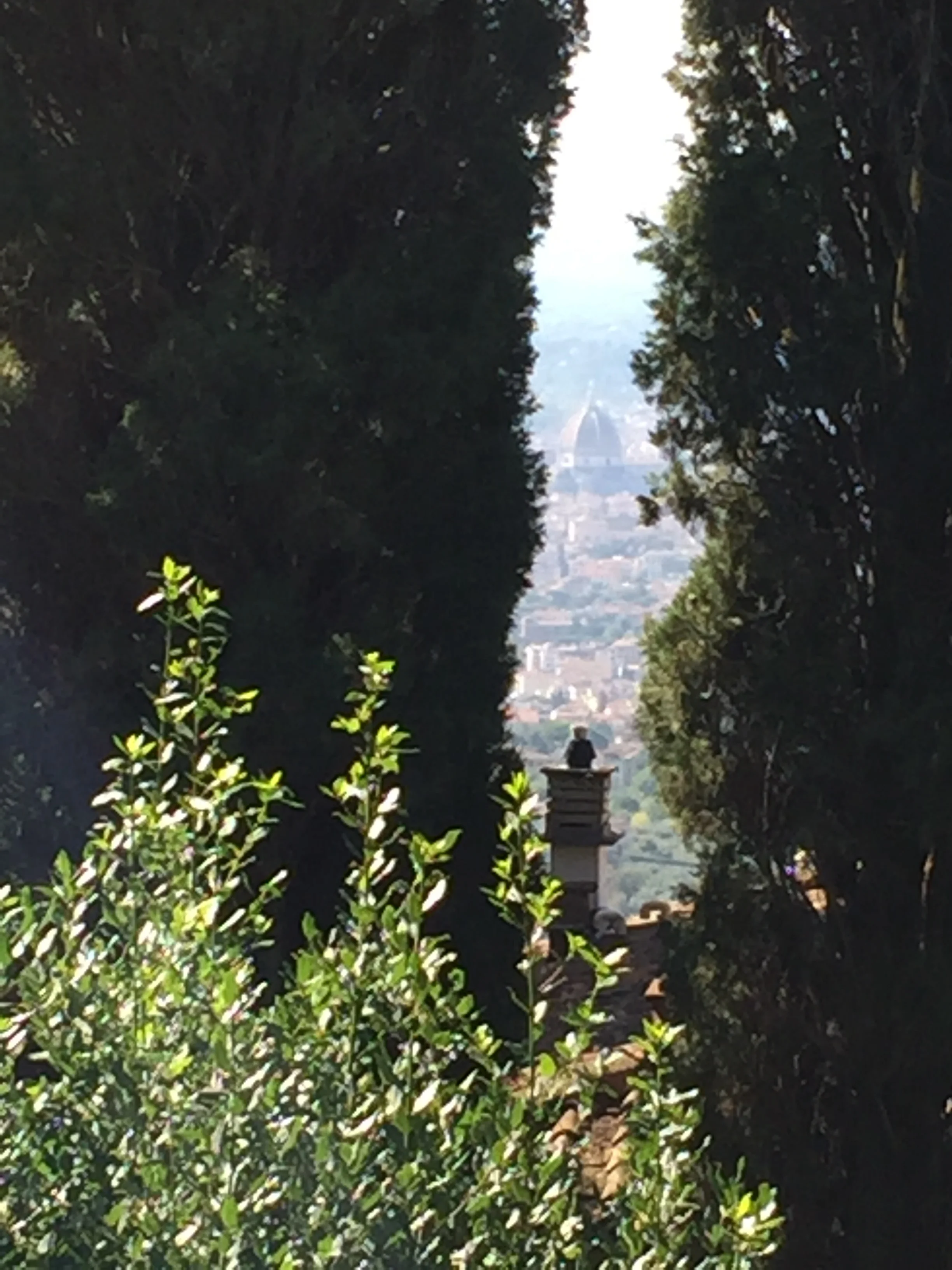
A portfolio approach to postwork means that you now have each day in front of you largely as a series of self-directed activities, over which you have control. Here is me in action; a photo I took in Firenze that shows the Duomo in mysterious miniature; it may not be a work of art but it was part of my portfolio approach last year.
Some principles of postwork
· Build your social network. You had it at work but now that’s gone: replace it.
· Define your purpose and your meaning in life postwork: you can change it over time
· Develop yourself: this is personal, and your ideas for yourself may not suit others
· Have fun: you can now; and best of all, the boss is not watching.
How can a portfolio look in practice?
You can be as busy as you want to be, this photo may not capture your mood. But - if you develop your portfolio - then you will be surprised how relevant it will become.
Renaissance art and retirement
What is the image of the practising artist today? Probably that of a solitary worker in a studio, but it wasn’t always like this. Many great Italian artists learned their craft through apprenticeship in a studio with other artists and a master painter in charge.
With their contributions of a leg here, an eyebrow there, they were not so different from so many modern workers who, working in teams, not only learn and practise their trade but also and often belong to an informal social club.
What I mean by this club is that the worker can also test personal ideas with colleagues such as: where should I take my next holiday, do you know any good handymen?
In its simplicity, the nature of this club points to a potential lack in the life of a person who has stopped working. Where can you find this club, these networks that you can use to test your thinking, learn new ideas, and prosper after work?
There is no single answer, it depends on the person, and a coach can be useful in helping to find the answers. It may be golf, it may be a mens’ shed, it may be connecting with people on the internet from other parts of the world to discover aspects of different cultures and languages.
The choice is yours. You are also an artist, a creator of the self.
A conversation with someone who recently stopped working
This wide-ranging conversation produced some interesting ideas about the feelings experienced when work stops. Some of them looking back, most of them looking forward.
There should be an acronym RDS that stands for Relevance Deficit Syndrome. It refers to the fact that the world of work continues without me and now I am not as important as I used to be! What about me! This will also encompass a number of feelings such as: people used to seek out my thoughts, opinions, guidance….what am I missing that work provided; loss of income; how can I make contributions to society (however large or small you want that society to be for you) now that I have stopped working.
There may be certain habits which you suppressed whilst you worked. I have in mind such weekday activities as sleeping in, watching daytime TV, doing nothing. Why not grant yourself permission to indulge in these things occasionally. Sure they were bad and wrong during your working life - after all you were not at home Monday through Friday - but now you can be kinder to yourself. Why not?
Now this person happens to have a working partner as distinct from a partner who was always at home. In the latter case there is the old maxim “I married you for breakfast and dinner but definitely not for lunch”. In the former case there is the challenge ahead of how they can enjoy end-of-day conversations together now that they no longer both work. A worthy challenge to rise to; not forgetting that the working partner may be heavily engaged in work projects and, as we know, that can be quite an overbearing theme throughout the dinnertime conversations.
To conclude on the topic of work, people sometimes fear retirement thinking that, once they leave their important job, that the world at work will collapse. What to say? To maintain a positive response, in my experience companies can usually survive the departure of an important executive. Sure the company will change somewhat, maybe for the worse, maybe for the better, but when all is said and done a retired person has bigger fish to fry: how to make meaning out of the new and exciting phase of life ahead of them for perhaps three decades. Avoid this kind of self-defeating behaviour I say and retire because you want to and you are ready.
Look forward. Good luck.
A financial planner's guide to retirement coaching
There are many ways in which a financial planner can strengthen relationships with existing clients, as well as gain new ones; and this article discusses one such strategy – called retirement coaching - that may be unfamiliar.
We have before us in our community a rapidy expanding demographic of retiring and retired people. This is not news to the financial planning community, nor to their well-serviced clients. What may be news to some is that this demographic will often benefit from the opportunity, as individuals, to sit with a coach and discuss a central aspect of retired life: what is my life’s meaning now that I no longer work.
Retirement coaching for retired or retiring clients is not the same thing as financial planning. Why is that the case? Picture a person, say 65 years old, recently retired from a lifetime of productive work. A financial plan is in place, that’s a given, and the planner works with this client to manage a good outcome.
Now the planner will also typically have a strong relationship with that client that, over time, will bring forward issues such as taxation and the creation of a will. The average financial planner, not being a specialist in those areas, may want to bring a subject-matter expert to the table. The planner will still manage the relationship with that client, but in the sense of overseeing the outcome with each of those specialists, while not getting directly involved.
This reminds me of the way in which a GP works with a medical specialist. As a patient, I will want to have a strong relationship with my GP, who is there to look after me on more routine matters but also in a holistic sense; yet I will expect my GP to refer me to a specialist with deep subject knowledge as any need for that might arise.
Let us return to retirement coaching and describe what it is in more detail. Most financial planners will have strong evidence from their clients that there is more to retirement than an income stream. Retirement for your 65 year old client above will also highlight the problem of finding a way to live a day-to-day, fulfilling life with its own postwork meaning.
After all meaning is what this client had every day at work for some 40 years. Does it really make sense to imagine that the search for meaning turns off like a tap at 65; soon becoming a daily cocktail of golf, cruises, TV, and so on? I don’t think it is ever that simple, which is not to discount those as earned activities in the first period post work. However, the bloom will fade quickly, I maintain, for the majority.
So, going back to our model of GP plus specialist; doesn’t it make sense for you as a financial planner to have a relationship with a retirement coach who will assist your client in finding personal meaning (and it is truly a personal meaning not a generic one) for this exciting and productive period of life after work?
Then you as a planner will have more time to address all those critical issues of giving financial advice in this ever more complex world of regulation and compliance. Sure, you can try your hand at retirement coaching, but is it worth spending your valuable time in that domain, given that you wouldn’t hesitate to recommend a tax or legal advisor? Also, a point of differentiation arises. This will be a good way to promote your business to new clients - in that appropriate age group - and will certainly enhance existing relationships.
In summary, retirement coaching is a strategy to both assist in the maintenance of existing client relationships, and a sales and marketing tool to grow a financial planning practice.
The Mona Lisa and retirement
The Mona Lisa, surely the most celebrated painting in the world, was stolen from the Louvre in Paris in 1911, but returned three years later. There is more to the story, such as who committed the crime and his motivation, but I want to look at the question of why this is the most famous painting in the world today.
I emphasise today because it wasn’t always as famous and it didn’t always hang in the Louvre. It is received wisdom that its creator, Leonardo da Vinci, was a genius. It seems to be the case that he was a dedicated worker, to put it mildly. So we have the twin ingredients for success: skill and hard work: tick those. But the notoriety surrounding the theft of the painting also, it seems, played a part in creating an aura around it that survives to this day.
We could call this the luck factor. So by this account, success has three factors: hard work, talent and luck. We normally don’t like to attribute our successes to luck (more likely we will bring bad luck into play when things don’t go well) as it disturbs the narrative we have created, but it’s usually lurking.
However luck has a positive side to it as well, and I want to discuss this in the case of a retired person or, as I call it, a person in the phase of non-work in life. I like to think about creating outcomes, you may want to call it a method of increasing the luck factor, by doing the following in retirement:
· Expanding your network of connections
· Being curious and aware of possibilities that may be good for you
· Experimenting and taking risks
Who knows, you may meet interesting people, discover further meaning in your life and altogether have fun.
But remember to pace yourself: you are no longer working!
Note: I heard about some of these ideas in a very interesting podcast called Rationally Speaking where they interviewed Robert Frank.
Teenagers and retirement
Why is it that it’s customary to pay money for gym membership in order to gain physical fitness, but not to pay a coach to help with emotional fitness in retirement? Is retirement a time for confusion or freedom? Let’s discuss.
Who remembers being a teenager? Who has been the parent of a teenager? It seems to be the case universally that it's a time of life when parents rant, lecture, bang on doors - take your pick - with the rallying cries of "get a job", "when are you going to start studying, you have an exam this week?", "do the chores we agreed on"; and so on.
And yet, on reflection it's surely a productive time of life, seemingly not much happening but happening it is, and most importantly the teenager is gathering strengths and skills for a long life ahead. Time is not a factor for the teenager, the horizon of life is not evident; yet.
You may disagree with my analysis, but what about retirement, when the time-line becomes evident and short as I will explain.
Picture life at 60. You are no longer a teenager and you have just retired. Statistically you have an average of 20 plus years ahead of you. Now remembering that statistics (to over-simplify) is about averages and variation around those averages, your individual destiny may be quite different - but let's stick with averages - then the clock is ticking for you.
We know time goes quickly so is retirement really the moment, the hour and the day to mope around the house? You won't even have dear mum and dad shouting at you. So why not plan, and in planning get the help of an expert retirement coach to help you get the most from your time to do what YOU want to do, by helping you to reach inside to find your true meaning in retirement.
Retirement is one of life’s big events, so take it seriously, get help if you need it.
Problem,cause,remedy
When you have a toothache what action do you take? Probably you suspect that you have a cavity or lost filling. You then visit the dentist. What does the dentist do? Probably after extracting some discomfort and money from you, the dentist fills the bad tooth and the problem gets fixed.
So, we have Problem >>> Cause >>> Remedy: to put the matter abstractly.
But this abstraction is also very powerful as it seems to capture, albeit at a high level, how each of us engages with a professional service provider: doctor, dentist, solicitor, tax accountant, financial planner, chiropractor - the list can go on.
The schema is: Problem >>> Cause >>> Remedy
OK, then this helps explain something to me that I have been pondering for months.
Suppose a retired person, after a lifetime of busywork, sits at home wondering what to do. Travel, grandkids, charity, golf, charity golf. The list continues. Now suppose as a second step that the wondering turns to anxiety, to arguments with the domestic partner, disputes with children, and a lot of engagement with the internet to no purpose. Then I would say that – potentially I must add as everyone is different – this could be a problem.
So following our schema above, a problem has a cause; isn’t that true? What is this cause? I would say in many cases it’s the lack of meaning in that person’s life. Meaning was dealt to them when they worked as: come to work, strive, achieve. Now if meaning is absent then its absence could be the cause of the problem mentioned above. But has our society recognised this? I don’t think so.
It’s only once that our society recognises that there is - potentially - a problem with a cause here that we can hope to move to the curative stage of finding a remedy.
A coach can help to find the remedy but first the retired person needs to recognise that there is a problem with a cause and only then can a remedy be found.
How can we educate society at large in these things?
Coaching, barbers and wives
Cutting hair is more complicated than you might think, do you remember the barber’s paradox?
If the barber is the person in a town who shaves all those, and only those, who do not shave themselves; then the question is does the barber shave himself?
You get a contradiction here: if he shaves himself then he shaves a person who doesn’t shave himself but if he doesn’t then he does!
Ok back to reality.
Take the test case of a married couple where the husband has recently retired. The husband may be struggling with retirement but not recognise the struggle as such, and therefore not look for help. The problem may spring from his failure to reconstitute meaning in his life since he left work, and certainly a good coach should be able to assist him in this regard.
On the other hand, his wife may see the problem very clearly. If she recommends that he should see a coach about this problem will he listen? In other words, perhaps he needs a gentle prod in order to seek that help. Moreover, this need may be painfully obvious to others but, as so often happens in life, he can’t see it himself.
Back to barbers: can the person who never asks for help in fact help himself?
Perhaps he needs help to get help.